

The last field note was 31 August. Since then two things landed on main that change how people get copper on a board and how they find the app: TraceMaker as an install-on-demand autorouter with weekly public binaries, and a homepage that leads with the desktop download.
An open router, not a bundled one
TraceMaker is DingoOz/TraceMaker, a C++20 autorouter released under GPL-3.0-or-later. Upstream publishes source. The v0.8.0 zip is an 8.7 KB KiCad plugin; v0.9.0 has no release assets. There is no official ready-to-run router binary.
fabPlane does not vendor TraceMaker into the desktop package. Settings → Routers lists three catalog entries:
fab_router— bundled on the PCB bridge- Freerouting — bundled in packaged desktop builds, otherwise downloaded as a GPL-3.0 JAR
- TraceMaker — weekly TensorFleet binary, with a source-tarball fallback
Unpinned projects still default to Freerouting → fab_router. Nothing changes until you pick a router in Settings, pin fabdesk.json, or pass router on route_run. Route Cinema uses the same picker. route_run accepts router=tracemaker and returns an install hint when the binary is not ready.
Weekly public binaries
A weekly job builds those binaries and publishes them on the same public host as the desktop installers:
- versioned archives under downloads.fabplane.com/tracemaker/
- rolling manifest: tracemaker-latest/manifest.json
The first public line is built from upstream v0.9.0. Current packages cover linux-x86_64 (cpu-only), macos-arm64 (Metal), and windows-x86_64. The Windows job is best-effort: a failed Windows build does not block Linux or macOS.
Each archive ships the upstream LICENSE and a SOURCE.txt pinned to the upstream commit. That is the GPL-3.0 source offer for the binary. Users do not need CMake to install a published package. They still need a matching OS and architecture: glibc x86_64 Linux, Apple silicon macOS 15+, or 64-bit Windows.
The prefix is not an index page. The manifest is the catalog the app reads.
Install when you need it
Settings → Routers downloads from that manifest into the per-user data directory, with SHA-256 verification. The card shows progress while a package is resolving, downloading, verifying, or extracting. You can cancel, retry, or uninstall.
If the public host is unreachable or has no asset for the platform, Install falls back to the pinned upstream source tarball. That package is installed but not ready until you build it or set TRACEMAKER_BIN.
Uninstalling the saved default router resets routing back to automatic. A saved default that is no longer ready makes unpinned route_run fall back to the automatic path with a note; an explicit router still returns the install hint.
This landed on main after the published desktop v0.2.146 nightly (7 October). The download page will list it with the next public build. The current public installers do not yet include Settings → Routers.
A homepage that leads with the app
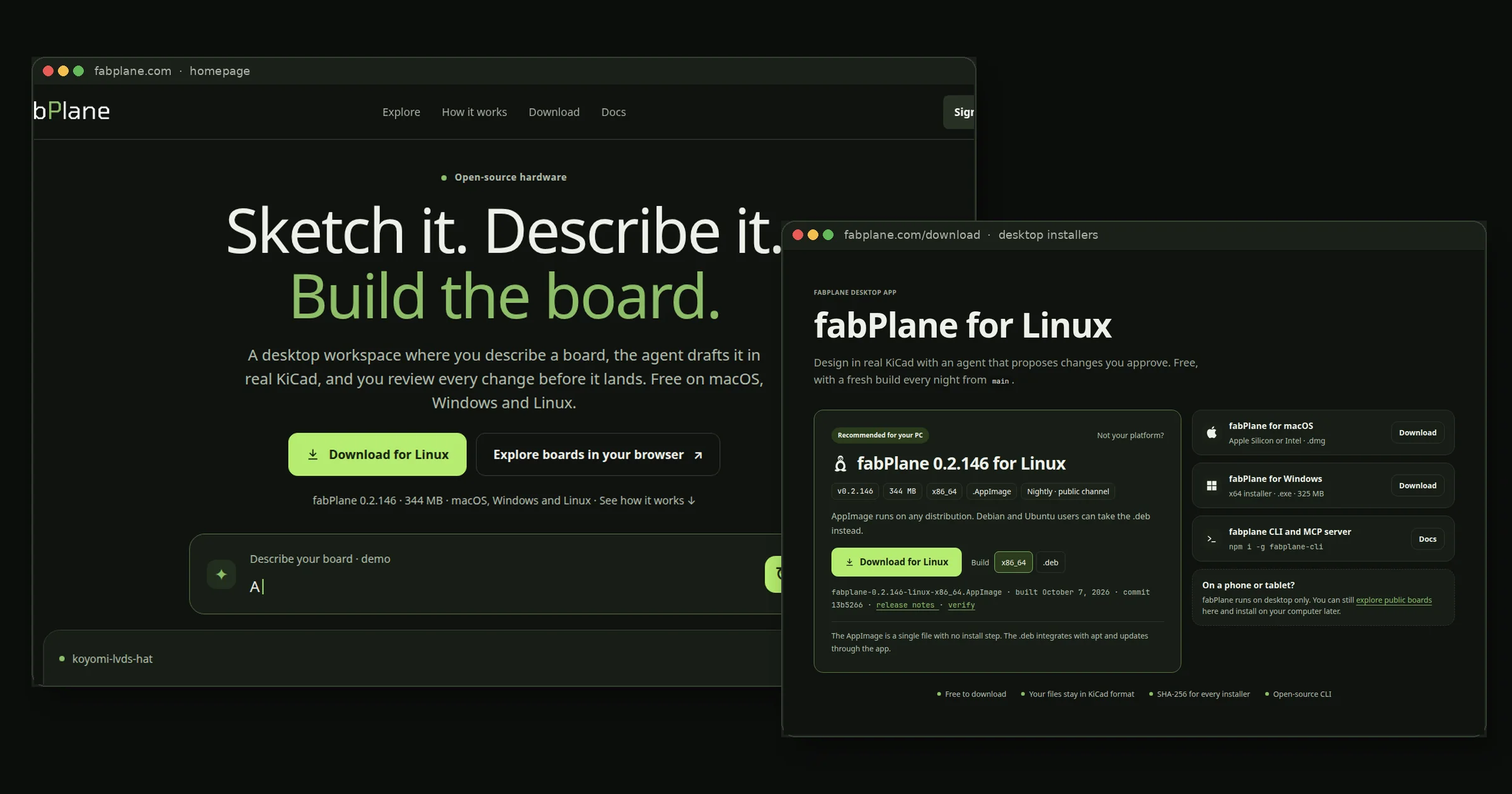
On 13 October the public site stopped treating the browser catalog as the primary action. The homepage hero is now Download for the visitor’s OS, with the version and — when a single build fits — the installer size under it. Explore boards in your browser is the secondary action.
Under the hero:
- a proof strip — built on KiCad, FreeCAD, and Freerouting; works with Claude Code, Codex, JLCPCB, and DigiKey; a new build every night from
main - “Already in KiCad? Open your project as it is.” The app bundles KiCad and works on
.kicad_prodirectly - a design-copilot section: describe a change, review the diff, apply it, then let the autorouter and DRC run
- a download band that recommends the visitor’s platform and lists the other two plus the CLI
The RGB circuit walkthrough stays on the page so #how-it-works still resolves.
The download page uses the same installer block as its hero: chips for version, size, architecture, and format; an Apple Silicon / Intel picker for Mac visitors; checksums; and a collapsed release history. Nightlies with identical notes are marked as rebuilds.
What this is not
TraceMaker is not the default router. It is not inside the v0.2.146 installer. The homepage on main now includes that download-led hero, the proof strip, the Apple Silicon / Intel picker, and rebuild twins on the download page. The in-app router catalog ships with the next public nightly after 0.2.146.
The previous note is still the right starting point for why the board source lives in Git: Why hardware needs version control.